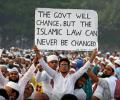
The AIMPLB appealed to the Centre to not undertake the Uniform Civil Code.

The Muslim Law Board contended that Uniform Civil Code, if implemented, will paint all people in "one colour" which will threaten the country's pluralism and diversity.
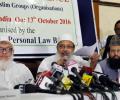
Calling for an 'enlightened debate' on Uniform Civil Code, Information and Broadcasting Minister M Venkaiah Naidu said the 'real mood' of the country was to end triple talaq and some people were trying to create confusion over the two issues.

In the face of strong opposition to Uniform Civil Code by Muslim outfits, the Congress on Thursday said its implementation would be impossible while the Bharatiya Janata Party asserted that the move is aimed at moving towards a progressive society.
'UCC should be across India and legally applicable to every Indian citizen.'

Minister of State for Minority Affairs Mukhtar Abbas Ansari believes a national debate on a Uniform Civil Code is a must. 'The need of the hour is to debate this issue at length in order to create a consensus,' Ansari tells Rediff.com, adding, 'Such a debate must take place at the grassroot level. We must understand all the divergent viewpoints before any draft can be prepared.'
Law Minister Kiren Rijiju said the government had requested the 21st Law Commission to undertake examination of various issues relating to uniform civil code and to make recommendations.

'Who is the government to decide about my religion?' 'We are governed by the Constitution. The Constitution has given me the independence to follow my religion.'

'Triple talaq and polygamy are likely to be the next ground on which Hindutva will assert itself.' 'And, as with other issues where this has happened, we must anticipate trouble.'
The AIMPLB is of the view that not only tribals but every religious minority should also be kept out of the purview of UCC, he said.

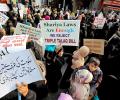
The All India Muslim Personal Law Board (AIMPLB) announced a nationwide movement against the 'deteriorating condition' and social and political marginalisation of Muslims in India, citing concerns over mob violence, demolition drives, and attempts to impose Vande Mataram.
Tthe Jamiat Ulema-e-Hind said it opposes the UCC as it is "totally against the religious freedom and fundamental rights guaranteed to the citizens in Articles 25 and 26 of the Constitution."
With its refusal to accept the modern social values, the Indian Muslim community is going down the slope of progress, says Najid Hussain.

The All-India Muslim Personal Law Board has, in its opposition to the move, submitted an affidavit to the apex court stating that though triple talaq is "undesirable", it is "permissible" in Islam.

After a meeting of its working committee in New Delhi, the board adopted a resolution which stated that the recent judgment of the Supreme Court on the maintenance of Muslim divorcee women is "against the Islamic law (Shariah)".

Reacting strongly to reports of the Law Commission considering proposals for reforms in Muslim family laws, the All India Muslim Personal Law Board has said the measures were "ill-motivated" and have been suggested "to pave the way for enactment of a uniform civil code of the Shariat laws".

Meeting in Lucknow, the board also urged the judiciary to take a serious note of "injustice" being meted out to the weaker sections and the minorities.
When the Muslim Personal Law Board promises 'advisories' and nikahnamas to the Supreme Court, one has to remember not only its recent campaign against any change in Muslim personal law, but also its past record of inaction on the question of triple talaq, says Jyoti Punwani.

'Every issue that Muslims are facing today affects Muslim women. But how come women's issues don't affect the community?' 'How does the community benefit by the practice of halala or polygamy?'

'A genuine tribute to Dr Ambedkar does not lie in selective invocation. It lies in asking a harder question: Is the Constitution still doing its job -- restraining even assertive majorities?' asks Manoj Mohanka.

Made at a time when an insidious agenda can be read into it, Haq is an important film that deals with a contentious subject with maturity, observes Deepa Gahlot.
He said there is a fundamental distinction between religious practices, rituals and civil rights.
In order to formulate a Uniform Civil Code, the Law Commission has sent out of list of 16 questions to gauge public opinion,
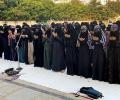
With discussions on the UCC taking centrestage, he said the BJP government in the state will move towards implementing one law for all, "only after talking to all the parties".

'The irony of this country is that the party in Opposition and the party in power both depend on Muslims.'

"Over a dozen Islamic countries such as Pakistan, Tunisia, Morocco, Iran and Egypt have regulated triple talaq. If Islamic countries can regulate the practice by enacting law, and it has not been found against sharia, then how can it be wrong in India, which is a secular country?" Prasad said.

'Only because of the absence of a dedication record in writing, how can such properties be treated as located on misappropriated government land?'
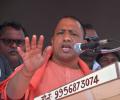
Adityanath called for an end to the Muslim practice of 'triple talaq' and advocated implementation of a common civil code in the country.
Crucial reforms in Muslim personal law, especially laws related to inheritance and adoption, need to be initiated forthwith; historically speaking, without the State's backing, hardly has any reform taken place or allowed to prevail, asserts Mohammad Sajjad.

The Union law ministry will file a consolidated reply on the issue in the apex court by the end of this month.
The application has been filed to oppose a batch of petitions on which the apex court had in 2018 issued notices to the Centre and other stakeholders while referring the matter to a 5-judge Constitution bench.

'There is something in our desh ki mitti that has held us together.'
'So many conquerors, colonisers, cultures came and went, but we withstood them and rose up again.'

Lashing out at both the opposition and ruling fronts led by the Congress and the Bharatiya Janata Party, the All India Majlis-e-Ittehadul Muslimeen MP Asaduddin Owaisi on Thursday said that neither dukandar nor chowkidar opens their mouths when Muslims are oppressed.

The Delhi high court on Thursday sought the stand of the central government and Central Waqf Council on a PIL seeking to declare that the Waqf Act is in violation of the Constitution and that private properties of citizens can only be governed by a Uniform Civil Code.

'Why is the government in such a hurry?' 'The answer is the December assembly elections and the 2019 general election.'

Modi can abandon the path of Hindutva only at risk to his position within his own fraternity. But if he pursues a hard line, he faces the risk of being hauled up by his coalition-partners. For the first time in a decade, Modi is not in enviable situation, observes Nilanjan Mukhopadhyay.

'My religion is great and it has given a lot of rights to women, but these intermediaries are interpreting it wrongly and ruining it.' 'I have great faith in our judiciary. I am sure they will see through the drama of men.'
The high court further observed that the triple talaq practice, sanctioned under Muslim Personal Law that governs marriage, property and divorce violates the rights of Muslim women.

Ansuya Dutt, who never stopped fighting for women's rights, can be an inspiration to us never to lose sight of our basic beliefs, never mind peer pressure.

'The mobilisation is nothing but a political ploy -- a sort of a fixed match between Hindu and Muslim communal forces, towards polarisation, in a run-up to the next election,' argues Mohammad Sajjad.
